
How Large Language Models Actually Work (Without the Math)

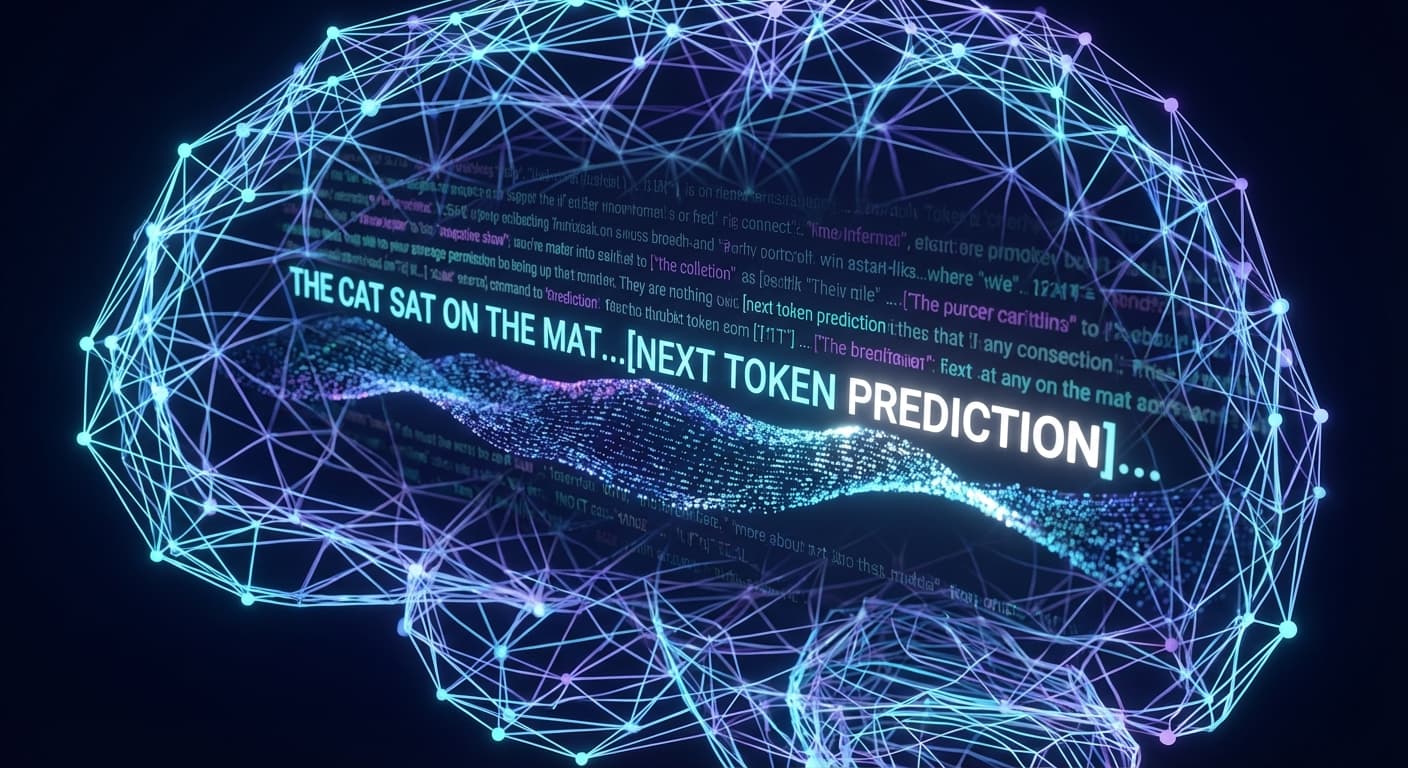
You type "Write a Python function to scrape a website," and three seconds later, Claude delivers 50 lines of working code. How?
If you've ever used ChatGPT or Claude, you've probably had a moment where you thought, "How does it know that?" It feels like magic.
But under the hood, there is no magic. There's just a lot of probability and a very clever architecture called the Transformer.
Most explanations of Large Language Models (LLMs) quickly descend into complex math—matrix multiplication, vectors, and gradients. As an AI Integration Engineer, you don't need to derive the backpropagation algorithm to build amazing AI apps. You just need a solid conceptual understanding of what the model is actually doing.
Let's break down how LLMs work, using zero math and plenty of analogies.
The Core Mechanism: Supercharged Autocomplete
At their absolute core, LLMs are doing one simple thing: predicting the next word.
Think about the IntelliSense or autocomplete in your IDE. If you type function get, your editor might suggest User, Data, or Props. It's making a guess based on the code you've just typed.
LLMs are essentially that, but scaled up to an unimaginable degree.
When you ask ChatGPT a question, it's not "thinking" about the answer in the way a human does. It's looking at your question and calculating: "Given this sequence of words, what is the most statistically likely word to come next?"
Then it picks that word. Then it looks at your question plus that new word, and calculates the next word. It repeats this loop, one word at a time, until it finishes the thought.
Key Concept: LLMs are probabilistic engines. They don't "know" facts; they know which words tend to appear near each other in the vast ocean of text they were trained on.
Tokens: The Language of Machines
I said "words" above, but that's a slight simplification. LLMs actually read and write in tokens.
Computers can't understand text; they only understand numbers. So, before your text is fed into the model, it's broken down into chunks called tokens.
- A token can be a whole word (like "apple").
- It can be part of a word (like "ing" in "playing").
- It can even be a space or punctuation mark.
Roughly speaking, 1,000 tokens is about 750 words.
When you send a prompt to an LLM, it gets converted into a list of numbers (tokens). The model processes these numbers, predicts the next number in the sequence, and then converts that number back into text for you to read.
Training: Reading the Entire Internet
How does the model know that "log" is the likely next token after "console."?
Because it has "read" the internet.
Training an LLM involves feeding it a massive dataset—Wikipedia, books, code repositories, Reddit threads, news articles—basically a huge chunk of the public web.
During training, the model plays a game of "predict the next word" billions of times.
- It sees a sequence: "The developer forgot to"
- It guesses the next word (e.g., "eat").
- It checks the actual next word ("commit").
- It realizes it was wrong and slightly adjusts its internal parameters to be less likely to guess "eat" and more likely to guess "commit" in similar contexts.
By doing this over and over for months on thousands of powerful GPUs, the model builds a complex internal map of how language works. It learns grammar, facts, reasoning patterns, and even coding syntax, purely by observing which tokens tend to follow others.
Note: Modern LLMs also undergo Instruction Fine-Tuning and Reinforcement Learning from Human Feedback (RLHF). This is what teaches them to follow your instructions rather than just randomly completing text.
The Secret Sauce: The Transformer and "Attention"
Before 2017, language models were pretty bad. They would lose track of the conversation after a sentence or two. If you told a story about "Alice," by the third paragraph, the model might forget Alice existed or call her "Bob."
Then came the Transformer architecture (introduced by Google researchers), which changed everything.
The key innovation of the Transformer is a mechanism called Self-Attention.
The Cocktail Party Analogy
Imagine you're at a loud cocktail party. You're having a conversation with a friend, but there are ten other conversations happening around you.
- To understand your friend, you have to pay attention to their voice and ignore the background noise.
- But if someone across the room shouts your name, your attention instantly shifts to them.
- If your friend mentions "that movie we saw," your brain retrieves the context of that specific movie from your memory.
Self-Attention allows the LLM to do exactly this with words.
When the model processes a word, it doesn't just look at the word immediately before it. It looks at every other word in the sentence (or document) and decides how much "attention" to pay to each one.
For example, consider this sentence: "The trophy didn't fit in the suitcase because it was too large."
When the model is trying to understand what "it" refers to, the Attention mechanism allows it to strongly link "it" to "trophy" and ignore "suitcase."
If the sentence were: "The trophy didn't fit in the suitcase because it was too small."
Now, the context changes. "Small" implies a container problem. The Attention mechanism shifts, linking "it" to "suitcase."
This ability to dynamically focus on relevant parts of the context—no matter how far back they appear—is what makes modern LLMs so coherent and capable of maintaining long conversations.
The Model's "Memory": Context Windows
LLMs don't have infinite memory. They can only "see" a certain number of tokens at once—typically 8,000 to 200,000+ tokens depending on the model. Once you exceed this limit, the model starts "forgetting" earlier parts of the conversation.
Think of it like trying to hold an entire book in your working memory while writing the next chapter—eventually, you'll only remember the recent chapters clearly.
Temperature: Controlling Creativity
You might have noticed a "Temperature" setting in the OpenAI playground or other AI tools.
Since the model predicts the probability of the next token, it usually has a few good options.
- Option A (90% likely): The most obvious, safe choice.
- Option B (8% likely): A creative, interesting choice.
- Option C (2% likely): A weird, nonsensical choice.
Temperature determines how risky the model gets.
For example, if you ask "Complete this sentence: The sky is..."
-
Temperature 0.0: "blue" (every time)
-
Temperature 0.7: "blue", "clear", "overcast", "painted with clouds"
-
Temperature 1.2: "arguing with the ocean", "made of forgotten dreams" (creative but weird)
-
Low Temperature (0.0 - 0.3): The model almost always picks the most likely word. It's deterministic, focused, and factual. Great for coding or data extraction.
-
High Temperature (0.7 - 1.0): The model takes more chances. It might pick Option B or even Option C. This leads to more creative, diverse, and "human-like" writing, but also increases the risk of hallucinations (making things up).
What LLMs Can't Actually Do
Despite their impressive abilities, LLMs:
- Don't truly "understand" meaning—they recognize patterns.
- Can't reliably do math (they predict digits, not calculate).
- Don't have access to current information (unless given tools).
- Will confidently make up facts (hallucinations).
Understanding these limits is crucial for building reliable AI integrations.
Summary
So, how do LLMs work?
- Input: Your text is broken into tokens (numbers).
- Context: The Transformer architecture uses Attention to understand the relationships between all the words, figuring out what's important.
- Prediction: The model calculates the probability of every possible next token.
- Selection: Based on the Temperature, it selects one token.
- Loop: It adds that token to the sequence and repeats the process.
It's not magic. It's a massive, statistical prediction engine that has learned the structure of human language by reading the internet. And as an AI Integration Engineer, understanding this probabilistic nature is the first step to mastering it.
Ready to put this knowledge into practice?
Open ChatGPT, set the temperature to 0.0 and 1.0 (if using the API or Playground), and ask the same question twice. Watch how the "attention" to different tokens changes the output.
Next Up: Now that you know how they work, let's talk about the jargon you'll hear every day. In the next post, we'll decode Tokens, Embeddings, and Context Windows with practical examples.

Frank Atukunda
Software Engineer documenting my transition to AI Engineering. Building 10x .dev to share what I learn along the way.
Comments (0)
Join the discussion
Sign in with GitHub to leave a comment and connect with other engineers.