
The Difference Between AI Integration and AI Development

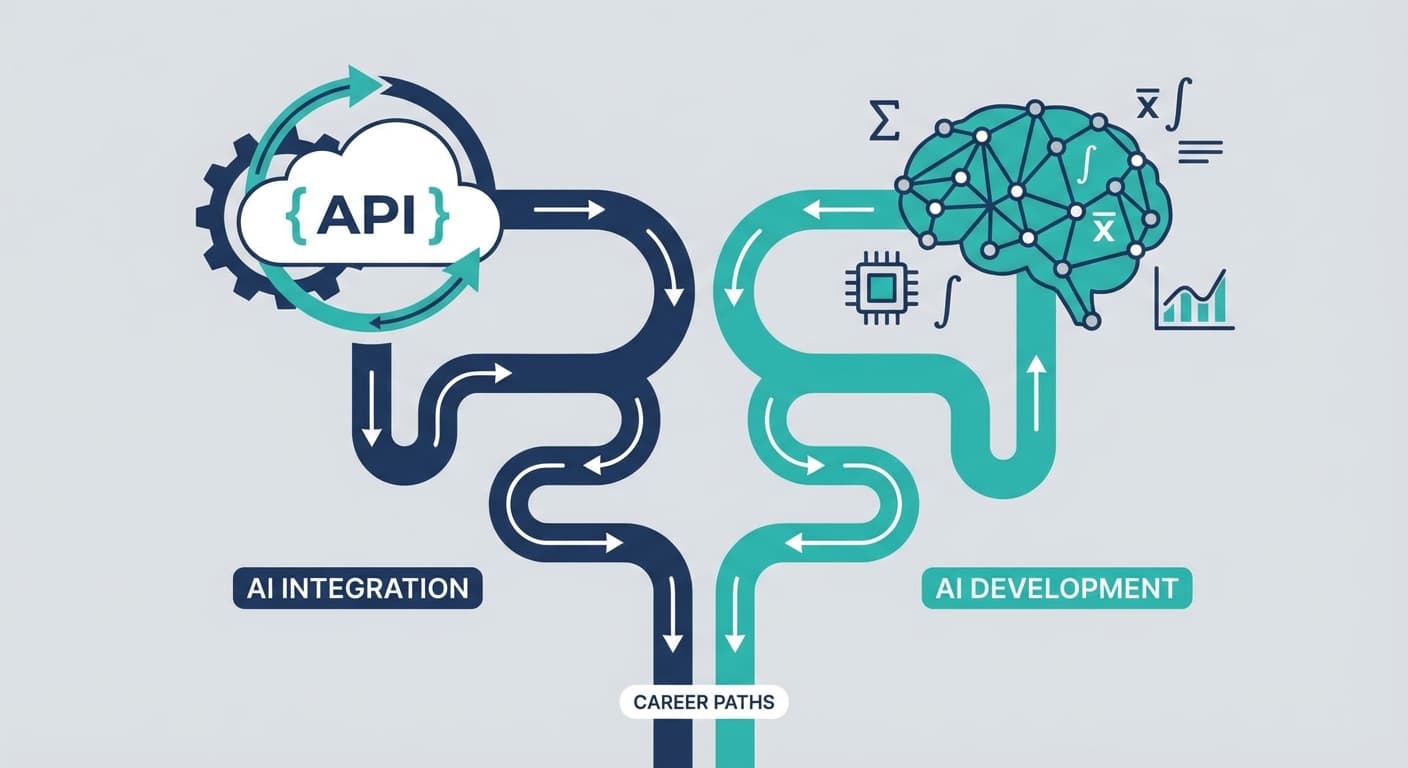
When you say you want to "work in AI," what do you actually mean?
This isn't a trick question. The term "AI" is used to describe two very different jobs, and most developers don't realize they're conflating them. One path lets you ship AI-powered features next week. The other requires months of learning before you build anything useful.
Understanding the difference will save you from studying the wrong thing.
The Two Paths: A Clear Definition
AI Integration (The "AI Engineer" Path)
What it is: Building applications that use AI models via APIs.
Think of it like being a chef who uses a blender. You don't need to know how the motor works or the physics of blade rotation. You need to know when to use the blender, what to put in it, and how to get the best results.
Examples of AI Integration work:
- Adding ChatGPT to a customer support app
- Building semantic search with vector embeddings
- Creating a RAG pipeline for document Q&A
- Implementing AI-powered content moderation
You don't need to know: Calculus, PyTorch, neural network architecture, backpropagation.
You do need to know: API design, prompt engineering, context window management, evaluation metrics, and how to handle AI failures gracefully.
AI Development (The "ML Engineer" Path)
What it is: Training, fine-tuning, or building AI models from scratch.
This is like being the engineer who designs the blender—the motor specifications, blade geometry, and power consumption.
Examples of AI Development work:
- Fine-tuning LLaMA for a specific domain
- Training a custom image classifier for your product
- Building a recommendation engine from scratch
- Optimizing model inference speed for production
You need to know: Python, linear algebra, statistics, ML frameworks (PyTorch, TensorFlow), and data engineering.
You don't need to worry about (as much): Frontend development, full-stack app architecture, or JavaScript.
A Day in the Life: Side-by-Side Comparison
Primary Language
- AI Integration: JavaScript/TypeScript
- AI Development: Python
Main Tools
- AI Integration: OpenAI SDK, LangChain, Vercel AI SDK
- AI Development: PyTorch, Hugging Face, Jupyter Notebooks
Typical Debugging
- AI Integration: "Why is the prompt returning bad results?"
- AI Development: "Why is the training loss not decreasing?"
Deployment
- AI Integration: Vercel, AWS Lambda, Edge Functions
- AI Development: GPU clusters, model registries, MLOps pipelines
Cost Concerns
- AI Integration: API token costs, response latency
- AI Development: Training compute costs, inference optimization
Collaboration
- AI Integration: Product managers, designers, backend devs
- AI Development: Data scientists, research engineers, MLOps
Skill Requirements Breakdown
AI Integration Skills
If you're already a web developer, you're closer than you think.
- JavaScript/TypeScript — You already have this.
- API Design — REST, streaming responses, error handling.
- Prompt Engineering — System prompts, few-shot learning, chain-of-thought.
- Vector Databases — Pinecone, pgvector, Chroma for semantic search.
- Evaluation — How do you measure if your AI feature is actually working?
- Security — Prompt injection prevention, data privacy, rate limiting.
AI Development Skills
This is a different skillset entirely.
- Python — NumPy, Pandas, and data manipulation.
- Math Foundations — Linear algebra, calculus, probability, statistics.
- ML Frameworks — PyTorch or TensorFlow.
- Model Training — Loss functions, optimizers, hyperparameter tuning.
- MLOps — Experiment tracking, model versioning, deployment pipelines.
- Data Engineering — Building data pipelines, cleaning, labeling.
Which Path is Right for You?
Choose AI Integration if:
- You love building products and user experiences
- You want to ship AI features quickly (days, not months)
- You're already a strong web developer
- You don't want to learn Python right now
- You want to stay close to the frontend and product
Choose AI Development if:
- You're fascinated by how models work under the hood
- You enjoy math and optimization problems
- You want to work at AI research labs or big tech ML teams
- You're comfortable with a longer learning curve
- You want to build proprietary, differentiated models
The Hybrid Path
Many engineers do both! A common trajectory:
- Start with Integration — ship AI features using APIs
- Hit limitations — "I wish this model could do X"
- Learn fine-tuning — the bridge between the two worlds
- Go deeper into Development if you're hooked
Fine-tuning is where the two paths overlap. It requires some ML knowledge, but you're not training from scratch.
Common Misconceptions
Myth 1: "AI Integration is just API calls. It's not real AI work."
Reality: Production AI systems are complex engineering. Prompt engineering, RAG architectures, evaluation frameworks, and guardrails are real challenges. Calling it "just API calls" is like saying web development is "just HTTP requests."
Myth 2: "You need a PhD to work in AI."
Reality: For AI Integration? Absolutely not. For cutting-edge AI research? Maybe. For applied ML engineering? Often not—many top practitioners are self-taught or have non-traditional backgrounds.
Myth 3: "JavaScript developers can't do AI."
Reality: Most AI features in production web applications are built by JavaScript developers using APIs. The model is a black box—you don't need to understand its internals to use it effectively.
Getting Started: Your Next Steps
For AI Integration
- Learn the OpenAI or Anthropic SDK — Start with chat completions
- Build a RAG application — "Chat with your docs" is the classic first project
- Study prompt engineering patterns — System prompts, few-shot, chain-of-thought
- Explore vector databases — Pinecone, pgvector, or Chroma
For AI Development
- Learn Python and NumPy basics — The foundation of everything
- Take a foundational ML course — fast.ai or Andrew Ng's Coursera course
- Experiment with Hugging Face Transformers — Pre-trained models are your playground
- Try fine-tuning a small model — Start with something manageable
Summary
Both paths are valuable. Neither is "better."
AI Integration is faster to start. You can ship features next week using skills you already have. You stay close to the product and the user.
AI Development goes deeper. You understand why things work, not just how to use them. The learning curve is steeper, but the ceiling is higher for certain roles.
The key is to know which game you're playing before you start training.
Not sure which path fits you? Start with Integration. Build something real. If you find yourself constantly wanting to peek under the hood, that's your signal to go deeper.
Next Up: Now that you understand the landscape, let's bust some myths. In the next post, we'll tackle the 5 AI Myths That JavaScript Developers Believe (And Why They're Wrong).

Frank Atukunda
Software Engineer documenting my transition to AI Engineering. Building 10x .dev to share what I learn along the way.
Comments (0)
Join the discussion
Sign in with GitHub to leave a comment and connect with other engineers.